
Making History Residency Diary | Arbroath Abbey & Hospitalfield, June 2024
Making History Residency Diary | Arbroath Abbey & Hospitalfield, June 2024
In early 2024 I was delighted to be awarded a Historic Environment Scotland and Craft Scotland funded Making History Residency which took place in June 2024, based at Arbroath Abbey and Hospitalfield in Arbroath, Angus. This residency was facilitated by festival and community project Arbroath 2020+1 as part of their Power & Word Programme. I enjoyed an intensive period of research, development and making in a week-long residency sited between the historic grounds of Hospitalfield and the purpose built Scriptorium studio within the Arbroath Abbey site.
The Making History project invites artists and makers to research a historic site and gives access to the HES archive’s along with access for site visits. I was invited to Arbroath to research the historic Abbey and develop a body of research and development work – not driven specifically by outcomes (which was liberating in itself) but supporting a period of research and ‘dwelling’ time to reflect on my practice particularly the connection I have using the book format to explore buildings and landscape to generate site specific installations and artist books. I was introduced to the Home-start Angus group (a local group offering support to parents-to-be and those caring for pre-school children) and later designed and developed a 6-week long community book project with the group, developing individual and group elements of the design for a book that we all worked on. These handmade and personalised books are designed to be used to explore positive memories and experiences as well as commemorating loss for parents and carers of the families referred to the support group; something that was particularly poignant for me at the time having recently lost my Mum in tragic circumstances. My Mum, Gillian Bristow, was an inspirational maker, poetry lover, expert embroiderer, micro-knitter and plantswoman; some of Mums influence, I have reflected on since, was unsurprisingly ‘quietly’ on my mind during this period of research and has been reflected in the processes used in making the community ‘Roots + Crowns’ books and artist books and the accompanying prints with stitch and hand printing.
The process working with the very warm and welcoming community at Home-start was as much about listening and observing as it was about making together – this was set up to work round the group’s activities while they can also access 1:2:1 support time. Archival threads, shared stories and hand-led experimentation all contributed to the textures and structures of the final pieces, which I later sewed together and will gift back to group members.
This blog post is a record of research, process and making during the week at Arbroath Abbey and there is to be an exhibition at Arbroath Signal Tower to show elements of work made during the residency and after developed in my studio in Melrose.
Toponomy (or the study of place names)
Arbroath (/ɑːrˈbroʊθ/)
Aber; confluence or river mouth | ‘Mouth of the Boiling Water’
Arbroth
Aberbreth
Abirbrothoke
Aberbrothock
Abirbrothoc
Aberbrothik
Aberbrothick
Aberbrothwick
Obar Bhrothaig (Gaelic)
Aiberbrothock (Scots)
Locating |
Brothock Burn | The Brothock Burn rises amongst farmland 1¼ miles (2 km) west southwest of Leysmill in Angus and flows east and then south-southeast passing Letham Grange and St Vigeans before falling into Arbroath Harbour, having completed a course of 7 miles (11km).
Monday 17th June 2024 |
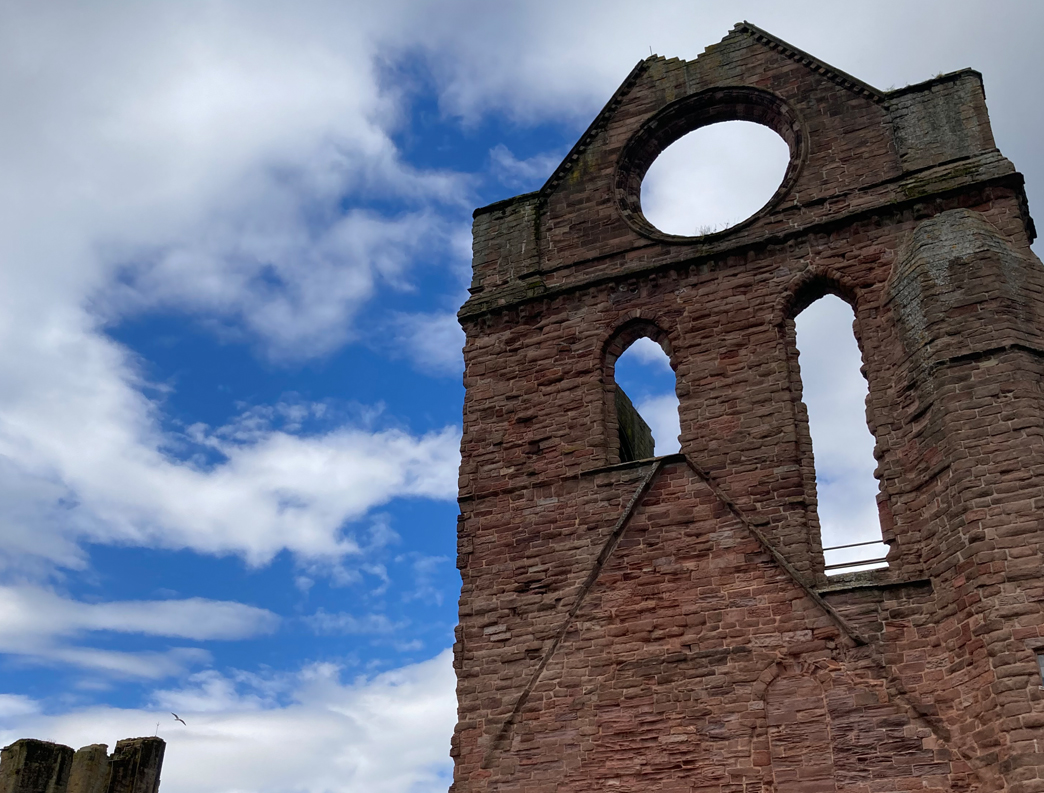
After an early start from the Scottish Borders, I arrived in Arbroath and headed straight up to the Abbey. I was settled into the Scriptorium quickly by the Staff (Fionna McGregor, Fiona Hall and later in the week Siobhan Ross – thank you), allowing me to experience my first solo lunchtime in the Abbey which closes at lunchtime. I started to explore the space I had arrived at and the site. The Scriptorium building, design by artist Bobby Niven, is located within the grounds of the Abbey as a temporary building; constructed to be raised off the historic grounds with a ‘touch the ground lightly’ approach to the historic site. I chose my working view, set out my materials and tools to face the Abbey, framed by the large square window of the Scriptorium; the view of the distinctive 12 foot ‘Round-O’ of the large circular window frame in the South Transept gable. My initial research in the archives had led to discovering that this window used to be a visual aid to mariners, illuminated red at night as a beacon guiding them safely into the Harbour where the name ‘Reid Lichties’ (‘Red Lighters’), a name derived for the towns folk has evolved from this tradition of lighting the Round O. Later when walking round the town this visual reference point of the ‘O’ is a comforting position to navigate round and to locate where you are, especially when getting to know the town – it must have looked extraordinary at night. Down one of the vennels in the town is a phrase spray painted onto a mural with ‘A RED LICHTIE a’ways finds thir ain way hame.’ This connection between the Abbey, the local community and the formation of the town is deeply rooted in place, time and heritage. This was also the reason I brought with me a selection of glowing, coloured paper vellum in a rich red and a blue – these colour references were already important to me, and was also chosen for the texture and translucency of a paper as an alternative to traditional vellum.
Something to note is that the medieval Abbey site was undergoing some extensive high level masonry inspections at the time of my visit that meant there were parts fenced off, but all was visible, and the sheer scale of the building meant that most often the eyes were directed looking skyward, so the Heras fences disappeared. It is key that buildings like Arbroath Abbey can still be visited and appreciated as an active site even during such important works. As an Architect I previously worked on historic buildings, drawing and annotating single stones for stone repairs, and appreciated that the level of recording and inspection HES are having to undertake is considerable especially now taking into consideration the environmental impact of climate change and weathering on these historic monuments. Preserve and conserve decisions being made all the time to ensure that out built heritage is sustained for as long as possible.
At this point it is also worth referencing the small but beautiful onsite Abbey Museum and visitors centre, designed by Simpson and Brown Architects. I had visited on a previous recce visit to Arbroath is where I encountered the limp vellum binding book structure I was going to be researching while in Arbroath – the book was the ‘Regality Register of Arbroath Abbey, 1288 – 1500.’ I think the structure was designed to contain this book and to display it in a museum cabinet rather than it is an original cover, but this format was of interest to me as a temporary way of covering books, slotting the book block in and out of the cover. One of the great joys of the book on display is that there are caricatures hand drawn in the gutter of the pages – presumed to be the Monks copying the text doodling in their boredom!
Another more famous historical document in the museum, that has also subsequently led me to looking at using vellum legal indentures as a book covering, is the facsimile copy of the 1320 Declaration of Arbroath. The original of which is too fragile to be on display but even the copy is an extraordinary document and structure – in a world now where digital signatures can be made at the touch of a button, [press return], this document was constructed to physically attach the personal seals of 8 earls and 40 Barons as it was the only way then to authenticate it as (signatures were not used then). As a document with the abundance of seals attached, it must have physically demonstrated the united show of support in the views being communicated – this level of material weight giving the document literal and visual weight as a show of intention and its importance.
My pre-plan for research and development was to work on the following strands of initial desk top archive research:
- Collect wildlife data while at the site, noticing – walking – speaking to staff (they have an unofficial wildlife journal – particularly interesting how during covid the graveyard was ‘rewilded’ in a sense as a fox had cubs undisturbed and other wildlife had the space to live undisturbed.)
- Collect small numbers of plant samples at Hospitalfield from the Physic Garden, photograph and form some kind of book structure to display the collections. Perhaps connected to 3. below.
- Continue research into Limp Vellum binding structures, test vellum papers. Try out a book structure for an Arbroath Smokie book form – the fish are split in two (the covers) gutted and hung from the tales (the binding) for smoking. Arbroath Smokies have Protected Geographical Indication (PGI) status, so must be made within a 5-mile radius of Arbroath.
- Following previous conversations with a staff member at both Hospitalfield and the Abbey about ground levels being built up at the Abbey (higher than street level) and the hedge becoming a barrier to the town and wanting it removed (!) it highlighted an interesting problem about communication between the site and the town. There is an existing flagpole near the hedge, ideal for a set of Abbey Signal flags?
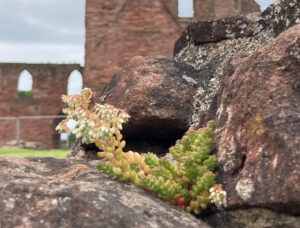
- Locate and record the rare white flower found at Arbroath Abbey, usually found south coast England but potentially because of climate change, conditions in microclimate warming, more suitable to a succulent – White Stonecrop or Sedum angelicum.
Watching the seagulls soaring above I started my daily wildlife tally, then I began to fold paper, this is for me a meditative making process – it has intention, is productive but also full of potential and takes away from the anxiety of the blank page, as within a few minutes I had made several sets of signatures from recycled cartridge paper; ‘almost books’ open to a narrative but not yet authenticated with my marks or personal seal.
Following a productive day, I headed up to Hospitalfield, I was staying in the main house in a ‘wing’ – it is an extraordinary building set on a beautiful surrounding site. Then featuring temporary sculptures of creatures pieced together from collaged elements with edgy expressions. Located within the historic walled garden is the new Fernery and a beautiful Physic Garden, with a quadrant of beds redesigned by Nigel Dunnett in 2021. This garden have been established and maintained by a Gardening Team supported by a volunteer group of gardeners, adding herbs in 2023 that were themed for three walks you can take around the grounds which have three themes – ‘The Sensory Garden’, ‘The Doctrine of Signatures’ (particularly interesting based on the ancient theory that plants bear a resemblance to the body parts or conditions that they treat) and ‘Dyes.’
Oyster Catcher I
Pigeon IIIII
Jackdaw IIII
Seagull IIIII
Wagtail I
Research References + Making research:
SCRAN
Canmore
Scotland’s Places – closed June 2025 now in Trove
Britain from Above
NCAP
The Architecture of the Medieval Page by Erik Kwakkel
Medieval and Early Modern Manuscripts by Special Collections Conservation, Yale
Echoes of Arbroath, An Arbroath Almanac, by Bruce Middleton
Arbroath, A Sixties Almanac, by Bruce Middleton
Limp Vellum Sample book – loaned by Ylva Dhanjso of NTS, Robert Smails
Training:
Leather, tawed leather and vellum qualities – part of QEST training with Tom McEwan
Limp Vellum Workshop – Society of Bookbinders, led by Mark Ramsden
Tuesday 18th June 2024
The next day I was up early, the light morning calling me to walk round the boundaries of Hospitalfield. I was walking and drinking a mug of tea in the Gardens when I met Lucy Byatt, Director of Hospitalfield stooped over and working her way along the Borders – quietly dead heading her way to work at the house. We talked about the development of the Physic Garden, the lush Fernery (the smell of the earth there is almost medicinal – it has a name; Geosmin, caused by the bacteria in the soil) the weather and then about loss. I knew it was going to happen, that I would need to talk about my Mum – grief comes in waves, we grow round our pain. The sense of shared loss was terribly sad, but that day was of a great comfort. We stood alongside each other talking to the flowering heads, and those on the turn being picked off, it really was facing life and death full frontal, choking on caught breaths. Death is inescapable and rude, I am not sure it can ever be peaceful, seems only in extraordinary cases anyone would be afforded a beautiful death and certainly not the norm in my experience. Faced with processing immense grief, I am very grateful to have had some unexpected and very grounding conversations with several complete strangers, offering glimmers of hope beyond, several of these during this week at the Scriptorium. Sharing death stories, understanding that families are blown apart, unexpected truths revealed, and being seen at such a low level, we need to acknowledge death more, talk about it and prepare for it better. We parted in good spirits, perhaps lighter of a load, and I took a while to watch the endeavours of the great number of bees landing and collecting nectar. The garden is a wonderful example of sensitive and contemporary landscape design, the walls protecting the planting and revealing more surprises as you step through them. I love gardens that feel like hidden worlds, productive too with potatoes and greens growing alongside dyers and medicinal plants.
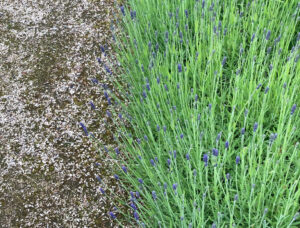
I picked what was to be the first of my daily sprigs of Lavender to take to the Scriptorium. I don’t like picking too many of one thing when I am collecting plant samples. I collect a few if the plant/ flower/ seedhead is abundant but a single stem becomes a reference to a memory of a time. Since the residency I found out that ‘Government and Vertues: Lavender is of special use for all the griefs and pains of the head and brains…’ which seems appropriate, from Culpepper’s English Physician and Complete Herbal by William J Ferrier, 1938.
Following a quick meeting with Cicely Farrer and Kristina Aburrow, to discuss the community group connections and links I could make I headed back to the Abbey.
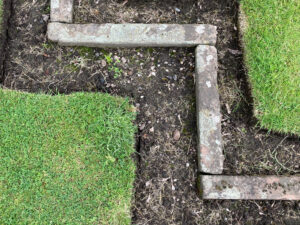
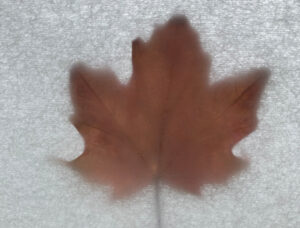
The Scriptorium was used as a base today, lots of walking across the site – in the morning I paced the exposed foundation heads cut out through the turf, also traced the line of roots cracking open the ground from several of the mature trees, collecting leaves from a nearby Maple, blood red stems. Also, investigating the red and white ‘hazard’ cordoned areas and taking time to look. I took the time to make some Smokie books, hanging them in pairs on the structural cables in the studio and also placing a concertina of Scots words and phrases related to the ‘Haddock or Melanogrammus aeglefinus’ within the structure of the space; then enjoyed the calm of the lunchtime lock-in while the abbey closes, with the whole Abbey to myself it was such a privilege to have that time.
‘Local names that have at some time been applied to haddock include the following: adag, attac, haddie, luckenar, nockie, peterfish, pipe, poot, pout, rawn and roan. Local names for different sizes of haddock include the following: jumbo for very large, gibber for large, kit for medium; calfie, chat, danny, norrie, pinger, powie and tiddley for small; ping pong and seed for very small haddocks. In the USA the names scrod and snapper are sometimes used for medium and small haddocks respectively. The size range indicated by a local name can vary considerably, even at one port, in response to changes in supply and demand.’ Web source.
| Foreign names | |||
| Danish: | kuller, hvilling | Italian: | asinello |
| Dutch: | schelvis | Norwegian: | hyse, kolje |
| Faroese: | hysa | Polish: | lupacz |
| Finnish: | kolja | Portuguese: | arinca |
| Flemish: | schelvis | Russian: | piksha |
| French: | églefin | Spanish: | eglefino |
| German: | Schellfisch | Swedish: | kolja |
| Greek: | gados, bakaliaros | Yugoslav: | ugotica |
| Icelandic: | ysa | ||
At lunchtime the staff also shared their nature diary, great to see such diversity noted – particularly during the time of the pandemic – with nature thriving. The Staff were brimming with local knowledge and training in medieval history, local history and a huge passion for the monument in their care I was given access to insights and facts about how the site was occupied and is used today. Invaluable conversations, and I encouraged visits to the Scriptorium during the week. Each day Staff popped down to see me – even bringing in some excellent bookbinding books to loan while I was there!
The colour red kept emerging from the site, life or death blood, red navigational lights, the rich colour of the red sandstone quarried from Scone, red Maple leaf stems and ‘Reid Lichties.’
In the afternoon I braced myself for the graveyard, I wasn’t sure I was going to be able to walk round it all as it is vast in scale and I wanted to run a mile from the rows of the dead. You walk in as if coming in behind the stones. However, I walked among the rows, taking time to honour the lost and to discover what I could from the lives told in stone of the Abbey. It was a warm afternoon and the stones were beautiful, the care and craftsmanship taken to sculpt the names of dearly departed in cursive or gothic style script, the shock of the ages and the reasons for death, the love shown in dedicating a memorial in the memory of a loved one, the sheer size of the family tombs, but also the detail of the symbolism in the designs for the mariners (many different ships, fish, anchors), physicians (mortar and pestle), master masons (compass) along with the death mask style silhouettes and portraits. The Abbey walls guard them all, again it helped – perhaps that is what grief is about, without the ability to lean into what is so uncomfortable we can’t begin to heal, not to move on or forget, but heal around our loss.
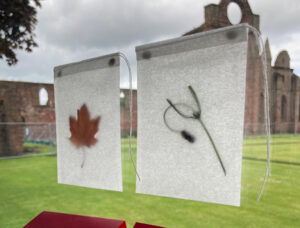
It was today I started to collate plant samples in the paper tea bags I had brought with me, enjoying the effused light through the paper, the glow of the leaf or flower within – jewel like. I also started to work with the paper vellum, forming folded sections using limp vellum binding details in abstract – working with the colours – red/ maple, blue/ lavender. That evening at Hospitafield, I found the most striking ‘Yves Klein’ blue delphinium flowers and collected several fallen flower heads. In making work there was [I recognise now] a kind of sorting and ordering going on, perhaps as makers we do this without realising but it did make me think about the importance of touch, of knowing your materials, the importance of making by hand and the connection to craft. There is space for AI, particularly if the energy consumption can be negated, but the more I read about it the more I am reassured that hand skills are going to be the most important and sought after skills to learn for future generations – so why is it so hard to train in Scotland, for example as a Bookbinder, especially as an older female maker, with a family?
A walk round outside the walled gardens this evening, led to the freshly cut grass circle at the large Beech tree towards the edges of the estate. Reassured by its presence I returned to the house, collected some more fallen Delphinium flowers and spent the evening sewing up six different styles of the most used sewing and supports for medieval and early modern bindings:
Book Structures Tested |
Single straight sewing – slit strap
Packed herringbone sewing – double strap
Packed straight sewing – twisted thong
Single straight sewing – single strap
Packed straight sewing – single cord
Single herringbone sewing – double cord
Many months after the residency while reviewing and reflecting on the work my research finds that the ‘Delphinium’ or more commonly known ‘Larkspur’ is a protective plant warding off negative energies and providing spiritual protection. The flowers used to be used to make a blue dye from by native Americans and European settlers. Not only this but Delphiniums symbolize openness to new experiences and an overall sense of positivity, while also Blue Delphiniums represent dignity and grace and deep emotional bonds. My Mums favourite colour was blue, perhaps there is a sense here of needing to make things ‘fit’ or to post-rationalise my choices but allowing the coincidences and the memories exist together was a comfort.
Paper: Artway ENVIRO Cartridge paper
Leather: J Hewit & Sons white tawed goat leather (Livingston)
Linen Thread: J Hewit & Sons, Coats Barbour 100% linen flax, white (Livingston)
Twine: Nutscene Neon Jute Twine (Forfar, Angus)
Oyster Catcher I
Pigeon IIIII IIII
Jackdaw IIIII II
Seagull III
Wagtail III
Crow I
Research References + Making research:
Medieval and Early Modern Manuscripts by Special Collections Conservation, Yale
The Gothic Cathedral, by Otto von Simpson
Bookbinding’s from the Victoria & Albert Museum, by V&A
The Practical Guide to Book Repair & Conservation by Arthur W Johnson

Wednesday 19th June 2024
Following my morning mug of tea in the Physic gardens and the walking routine collecting the daily Lavender ‘sprig’ I headed first to Arbroath Signal Tower Museum, a very original local museum with a fascinating collection of local materials relating to the design and construction of the Robert Stevenson designed, Bell Rock Lighthouse which is based on Inchcape Rock, also presenting the relationship with its onshore base at the Signal Tower complex. The Bell Rock lighthouse is the UK’s oldest ‘sea-washed’ lighthouse, a beautiful term for the powerful, abrasive sea action on the man-made lighthouse structure. I like the idea of a mental sea-wash – a good description for how it feels after meditating.
I was transfixed by the working lens mechanism from the Bell Rock Lighthouse in the Lens Room, also the model of the interlocking foundation stones showing the lighthouse construction and the giant blueprint plans on display were fascinating. However, it was the communication method that was developed between the Signal Tower and the Bell Rock lighthouse that was particularly of interest as a means of communicating visually if things were ‘all well’ at each station. The details are captured in the ‘Book of Signals, 1814 edition of 2 copies’ devised by Stevenson.
The idea was developing for me to design a series of flags or a windsock/ flag for communicating to the town from the Abbey, to let visitors and the local community know that they were open and ‘all was well’. What would the Abbey staff want to communicate, how it is interpreted? Reflecting on the Flag and copper ball system developed for communication by RL Stevenson at the Bell Rock Lighthouse. The copper ball was raised daily, and watched out for between 9am – 10am, when identifying if all was well at the Lighthouse; if it was not raised during this time, it was usually a sign of a problem or illness. Would the HES staff consider raising a flag to communicate over the hedge? This felt like an opportunity for a design, to connect communities and reflect on the systems that been used in the past.
I also took time that day to return to the Abbey Museum and was drawn back to the Regality Register and also to a small exhibit of a stained-glass fragment with an oak leaf pattern hand painted onto it, the connection between the natural world, trees and roots, the roots and foundations of the building complex revealed in the ground and the natural world were recurring pre-occupations during my week and the inspiration for my community workshops with the Home-Start group.
Oyster Catcher I
Pigeon III
Jackdaw IIIII IIIII IIIII IIIII IIIII II
Seagull IIIII IIII
Crow II
Research References + Making research:
Medieval and Early Modern Manuscripts by Special Collections Conservation, Yale
Book of Signals, by Robert Stevenson [extracts], 1814
The Wild Remedy, How Nature Mends us – A Diary, by Emma Mitchell
Floriography, by Jessica Roux
Arbroath Signal Museum – combination ball and flag system of signalling [a reflective copper ball, reflecting the sunshine]
Thursday 20th June 2024
Summer Solstice
After my breakfast of fried egg and sage roll from the Hospitalfield kitchens (I never knew fried sage in butter was so delicious!) and my daily Lavender stem collected I headed to the Scriptorium with the intention to spend the morning photographing the tiny sedum plant I had successfully found thriving at low level on the wall heads of the exposed foundations – this plant is White Stonecrop or also known as Sedum angelicum. Described online as ‘…low to short, mat forming, often straggling plant, leaves alternate, bright green, often tinged red, Flowers white 6-9mm in much branched flat-topped clusters on erect stems; follicles pink, erect…’ during June it has tiny star shaped white flowers in abundance and the fleshy leaves start to turn pink, orange. When I was there the flowers had developed as buds, and the stems and leaves had mottled green and Russett red coloured markings. The resilience of this little plant to keep low and survive, developing its fine complex structure of roots in a mat across the stone wall heads means it is sitting lightly, but gripping tightly to its environment, the previous years stems and flowers falling to the roots and decay each year, returning itself to the soil. Patches growing in sheltered pockets, from erosions and cracked areas of the stone walling – survivors, migrating as a species from more southern locations to now be able to thrive as climate warms in the UK.
I had a visit from Andrew James from HES, who has been an enthusiastic lead on the Making History project. He’s been incredibly helpful with archive access and in discussing ideas for the community workshops. His passion for collaborating with Craft Scotland on the Making History series of commissions really shines through, demonstrating how heritage can be explored in fresh, inclusive, and accessible ways.
‘Through the framework of the Making History series, artists and makers are playing a vital role in connecting communities; particularly those who may not usually engage with Scotland’s heritage – with the stories, places, and traditions that shape our shared past. By using craft/ making as a creative and hands-on way to engage, Making History is opening new ways for people to experience and contribute to the evolving narrative of Scotland’s cultural identity.’
Following lunch in the town, I settled back into the site by walking the foundations again – it was a reflective moment and I considered an idea about whether ‘Crowns + Roots’ may also reference loosely the connection to royalty at the Abbey. I was also referencing the ‘Crowns’ of the trees surrounding the site. It was much later last year that I discovered that the gesture of crowning also has religious references to the ‘Crown of Life’ in Revelation 2:10, ‘Be faithful unto death, and I will give you the crown of life…’ along also with the crowning of a baby’s head before the flood of life at the moment of birth. My attention turned to the Round ‘O’ of the Abbey gable wall and the circle of life/ death I was preoccupied with all connecting to the work I was developing, but not yet tying the ideas down into a book structure.
I had been operating an open doors studio at the Scriptorium, and welcomed some visitors to the site over the week – dogs, artists and one specific maker who I had met on Instagram (great to meet a paper marbler I had been in touch with in-person – Carey of Studio Carey Brett). The most poignant visitors were two women visiting Arbroath and we fell into a conversation which very quickly became a discussion about dying, traumatic death and the loss of a parent or partner – it was raw, but grief as a process is and I was (still am) grieving a very difficult loss of my Mum, with many questions unanswered. What we agreed (at that point) was that grief doesn’t get smaller, you grow round it and it is not a simple 5-step process aligning with the official ‘stages of grief.’ Sometimes you go backwards, to be able to go forward but whatever way you can, but it has to come out and the practical ‘making’ I reassured myself was going to help me.
The rest of the day was spent working on abstract paper vellum closure structures cutting tongues of the tawed leather to size, to tie through itself to the pierced and folded paper vellum structures. The work was about considering the possibilities, testing the materials and as not using traditional vellum parchment I was able to make the mistakes I needed to without fear of wasting valuable materials.
When I got back to Hospitalfield I was back in time to meet two of the local artists who were on residencies; illustrator and artist Rosie McGregor and interdisciplinary artist Monica Lucia – chatting for a short while with both under the trees in the grounds it was lovely to have conversations about motherhood and creativity, making art and music for mental health and the opportunity that residencies afford creatives to experiment, to make the mistakes to be able to move forward with work.
My plan for the rest of the day was to make a ‘Crown of Life’ for the evening to leave at sunset, placed at what I was thinking of the ‘Mother tree’ in the grounds of Hospitalfield – I would walk to visit her (the tree) every evening and knowing my Mums connection to the seasons, her passion for the astronomical events, the path of the moon through the year and celebrating the natural rhythms of the seasons it felt the right form to construct and remember her by, laying it under the Strawberry Moon.
It must be noted that the connection between the contemporary Funeral Crowning Ceremony which involves placing a ‘Crown of Life’ on the deceased’s head was not known about by me until a long time after I had made this private work. I did not see my Mums ashes interred, so this at this time was my version of a personal committal of laying her gently, returning her back to the earth.
The ‘Crown of Life’ was made up from long stemmed ‘weeds’ found in abundance at the edges of the site; I think it included Italian Rye Grass, Yorkshire Fog, False Oat Grass, Daisy, Buttercup, Common Vetch and Wood Cranesbill. I wound and tied the grasses with their own stems and then intertwined the flowers to make a circlet.
At 10:05pm, a golden hour beautifully lit, at the mother tree I laid the ‘Crown of Life’ in the centre of the open boughs, protected over the heart wood of the old Beech, Fagus Sylvatica – or ‘Queen of the Woods’ often associated with wisdom and knowledge (writing and deep thought), femininity (in Celtic mythology it is linked to the feminine deity Fagus) and knowledge and communication (thought – its smooth bark being carved with runes, messages and more modern initial inscriptions).
Beech Tree – Book Fact |
Early writing tablets were made of thin slices of Beech, later bound into books – connecting the tree to the written word directly.
I have always considered my practice is a transformative process, for myself as well as through the materials I use – but it is only until months after that period I realised I was using my making to support my grief, it was building my resilience and the ability to connect with my practice directly. There is also a case that great grief sharpens your mind to what you really should be doing with your life, and this is also why the residency was transformational as an experience. It was the right time to be there and a very positive time.
Oyster Catcher I
Pigeon III
Seagull IIIII
Reading References:
The Clearing, by Samantha Clark – a memoir about ‘spaces between’
A Spell in the Wild – A Year (and six centuries) of magic, by Alice Tarbuck
Friday 21st June 2024
Morning tea, Lavender sprig collected early – brief morning chat in the physic garden with LS about my research and preoccupations and was leaving with gratitude for the help and support from the Hospitalfield team and the artists I had met. Packed up, I headed to the Abbey to work, it felt good to be working in the Scriptorium regularly and using it in the way it was designed to copy and make books in, also exploring and tracing threads of life, language and growth I had been researching in my time.
I had been carefully placing plant samples in the paper tea bags during the week, testing them out hanging in the breeze, now captured in the coloured paper vellum books I finished making, the translucency of the fine paper glowing with the colours held within. The process of my making was playful, making patterns, looking at colour connections between the plant samples from Hospitalfield and the Abbey – selecting the colours I was drawn to, exploring the symbolism of plants I collected.
I made rubbings of leaves on the paper vellum and then headed outside took a final walk round the graveyard, viewing the backs as well as the fronts, where the stone was splitting off from the weathering over the years making beautiful patterns, revealing layers and natural texture. Eventually the gravestones would survive longer than the family that tends the graveside, slowly dissolving back into the earth as well.
Turning my attention to the site of the Abbey again, focussing on the area outside The Scriptorium I took time to record the area behind the red and white striped chain-link hazard barriers protecting an area of wildflowers – my plant finder app telling me there was Cowslip, Cornflower, Yarrow and Red Campion (possibly!) along with various grasses, but these are identified from the immature leaves, there was an abundance of them developing. The importance placed on their protection with the bright barrier flagged that they were not to be disturbed. Researching the uses of red and white posts and fencing it is flagged up they are not only to deter foot traffic but also mechanical traffic like the mowers that powered up and down the turfs alongside the foundation tracks.
The time I had at The Scriptorium was a rich and engaging experience, the approach to CS and HES offering supported time to research and develop work was both liberating and productive and along with the work I made that week, I have since been developing the artist books I will show with some of my research in the exhibition at Arbroath Signal Tower Museum, 9 August 2025 – 3 November 2025. I also have several small projects I would like to develop further, a rich resource to work from.
Pigeon II
Jackdaw IIII
Seagull II
Research References + Making research:
The Man who Planted Trees by Jean Giono
The Wisdom of Trees by Max Adams
‘Snow’ by Carol Ann Duffy (A favourite poem of Mums shared with my daughter who was studying CAD).
‘Leaves’ by Derek Mahon – Selected Poems (I found a clipping about this poem in my Mums note books).
‘Somewhere in the heaven
Of lost futures
The lives we might have lived
Have found their own fulfilment.’
Leaves, by Derek Mahon (extract)
‘In each of our own storms as we grew and took flight,
your steady light held in the evening light.’
Mother, to mother, by Felicity Bristow (extract)
With special thanks:
I am very grateful for the time I had to work in Arbroath at the The Scriptorium and at Hospitalfield and really enjoyed the opportunity the Making History Residency gave me to take time to explore something new but connected with my practice, I taught myself new skills and have gathered an overwhelming amount of written and visual research. Oddly it landed at the right moment while in grief as it gave structure and a new momentum, and I would like to take the opportunity to thank the following very much for their time, advice, support and the ‘Rose and buds’ of good conversations while I navigated the ‘thorns’ of that time.
Andrew James, HES
Irene Kernan, Craft Scotland
Lucy Byatt, Cicely Farrer, Kristina Aburrows, Hospitalfield & Arbroath Festival Staff
Fionna McGregor, Fiona Hall and Siobhan Ross, Arbroath Abbey Staff
Shona Arbuckle, Home-Start Angus
Anika, Amy, Beth, Carla, Drew, Kat, Lynn, Meghan, Meredith, Michelle, Misha, Mya, Rachel, Rachel D, Shona, Steph, Tina and Tracey, Staff and Volunteers, Home-Start Angus Participants